

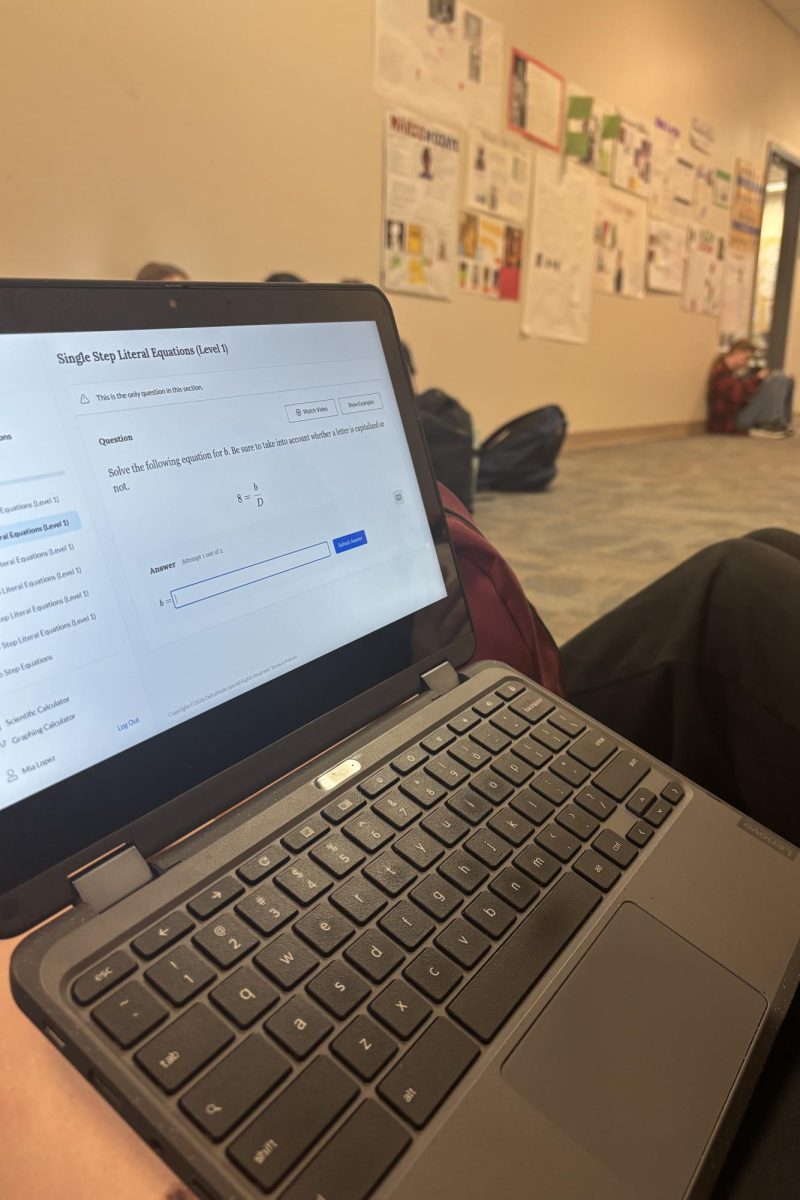
Covid-19, or the Coronavirus, was a pandemic that sent the entire world into what felt like a new reality, creating a new normal of social distancing and isolation. Thriving in the early 2020s, starting half a decade ago, society had lived through an event that would make its way into history books.
Covid-19 had impacted not only the outside world but the academic world too, for both students and teachers. Looking back on an outcome of poor mental health during the time, many report that online school and lockdown itself were a horrible experience.
“When I was in online [school], it obviously wasn’t as direct as in person, so it was harder to focus, and it really negatively impacted my learning,” said Blake Massie, sophomore.
One thing online school lacked was the ability to form connections with the teachers, which many students agree was a contributing factor to the poor experiences during lockdown learning.
“I was more grateful for in-person school [rather than online]. I need the connection of in person, so online I found it stupid and like it didn’t matter,” said Kate Hall, senior.
By being online, school felt much less of a requirement–partly because some students stopped worrying about their education, and partly because the school had less of a way to control the kids.
“School had far less enforcement power,” said Uriah Cross, AP and GenEd History teacher, “A lot of the time, the kids weren’t physically in the room during Zoom meetings, so all I would get was a nice view of their ceiling fan.”
With the struggle of trying to get kids to apply themselves, many found it hard to motivate, resulting in the feeling that classes simply didn’t matter.
“I failed most of seventh grade because I was online,” Hall said, “I failed it because I didn’t do online well, I just didn’t care.”
For those who really tried to retain some information online, focus was a hard thing to come by, especially when it initially comes down to teaching oneself.
“I think it was really hard for [students] to focus, and the distractions at home definitely contributed,” said Laura Brackey, English teacher.
Especially for younger students, who were not required to focus on school work up until that point, found it difficult to concentrate on assignments, Zoom meetings, and tests.
“Online [school] was a whole different experience for me […]. It switched my environment completely,” said Trinity Pham, freshman.
Along with this new environment, education had changed as well. Trying to teach so much in such a little amount of time in these Zoom classes ultimately caused changes in the way things were taught.
“A lot of academics is scaffolded–meaning it’s one small step, and then another small step, and then another small step. Online school had removed some of those steps, making them jump three or four extra steps at once, which can be a very difficult thing,” Cross said.
Not only were students limited in how much time they could learn with a teacher present, but teachers also had a time limit on how long they could teach, resulting in certain factors being cut, creating bigger jumps and more information to learn at once.
“We had a lot less time to teach things to our students, so it caused us to really reflect on the material we had, and just pick and choose the most important things,” Brackey said.
Picking the important material to teach to help students was a difficult task. However, it was not just choosing what to teach. As hard as it was for students to apply themselves, teachers also had to switch up their teaching methods.
“It took even more effort for my kids to reach the top of the charts,” Cross said, “The college board, during COVID, only forced my kids to write one DBQ. No multiple choice, no LEQs, no SAQs, it was one quarter of the assessments any AP student now would have to take.”
This learning situation ultimately led students to finish the year with an easy way out, which also resulted in a gap when it came to comparing students from different years.
“There was a learning gap for some of the students,” Brackey said.
The entire online process hindered the possible education many students had a right of receiving, but despite drastically changing the education system for those few years, it did result in some outcomes that would come in handy later on, as the use of technology increased.
“Going online taught me more on how to use a computer, and how to rely on technology,” Pham said.
While starting with the reliance on technology early, it set people up for the upcoming mass-usage of technology in all aspects of life.
“I learned to be very tech-y at that time,” Brackey said.
While some good managed to come out, it was all-in-all a very hard time for adults and children alike.
“Due to government decisions, like shutting down schools, I don’t think that they looked at the auxiliary consequences of that,” Cross said.
A lockdown seemed like the probable thing to do to avoid getting more and more sick, but it was not entirely thought through. A constant downside of the lockdown was the intense isolation.
“COVID impacted society because it gave everyone lots of alone time, and so not seeing everyone for a long time affected people, and made it weird coming back into society,” Massie said.
After such an isolation, it was almost impossible to be expected to just return to society and treat it as it was just prior to the lockdown. Even now, six years after the virus, there are changes that continue to linger.
“I think COVID pulverized society. […] It divided society greatly, and we’re still feeling the effects of it,” Cross said.